SmartBDM
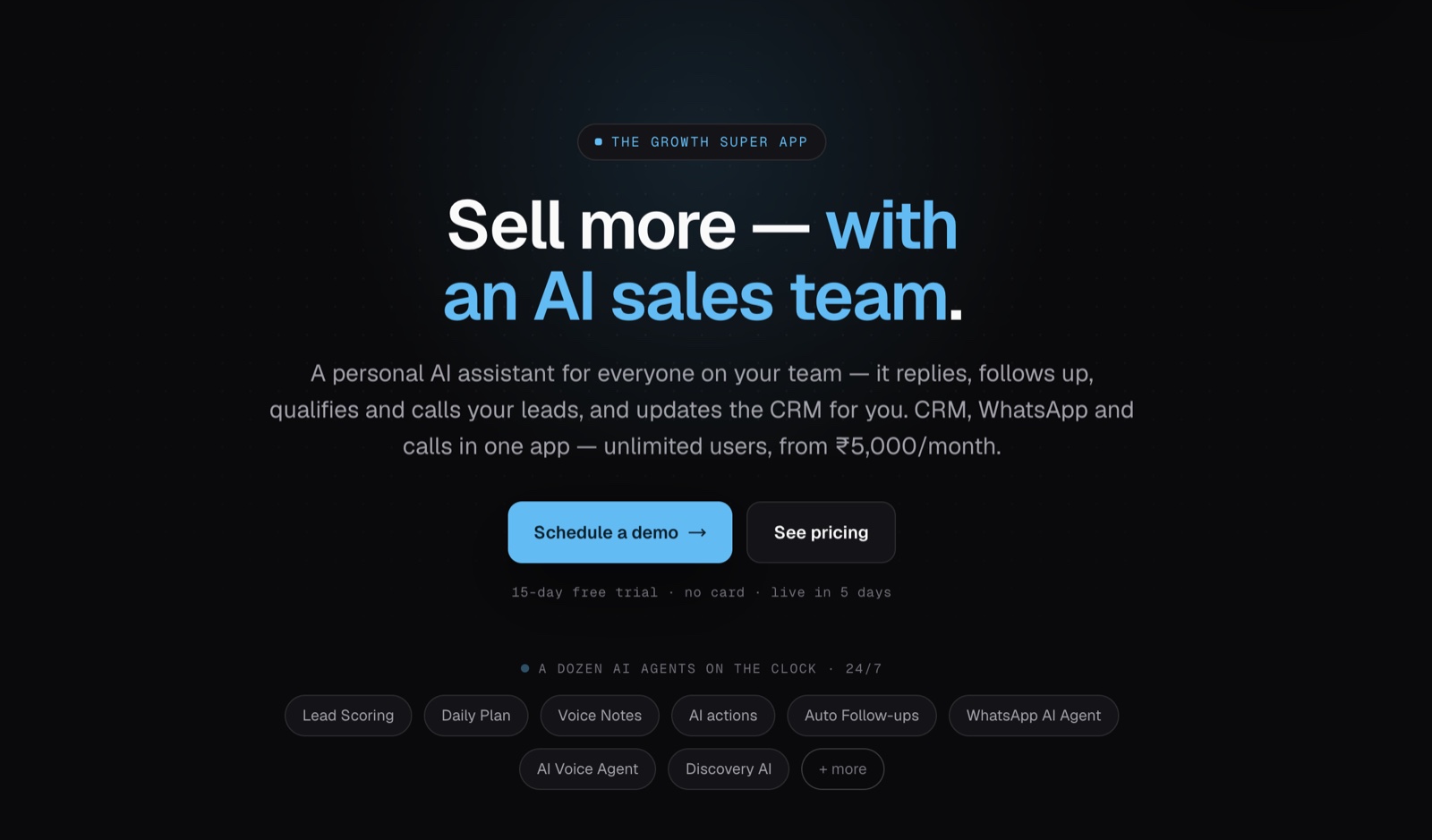
An AI sales team with CRM, WhatsApp, calls, and follow-up in one place — so no lead goes cold.
AI voice agents now hold real conversations in major global and regional languages, at any time of day. For the first time, multilingual and after-hours customer engagement can be served at the scale and cost of a digital channel.
Enterprise voice today depends on human agents for inbound support, outbound sales and collections, appointment reminders, and IVR menus. Coverage in one or two dominant languages is the norm; broader multilingual coverage across the regional languages a customer base actually speaks stays rare because the headcount math is hard to justify. After-hours and weekend service is typically skipped or outsourced. IVR phone-trees handle the volume that humans can't, but abandonment commonly runs above 30% in financial services, telecom, and utilities. Outbound dialing capacity sits at 30–40 calls per agent per day. The cost-per-conversation curve has been flat for years.
Multilingual voice models in 2025–26 hold real conversations in dozens of global and regional languages — including code-switched speech — that most customers don't recognise as software in the first thirty seconds. The cost-per-minute economics are an order of magnitude below human agents. The deeper shift isn't just cheaper calls — it's that calls which were never economical become viable: every inbound answered at 2am, every lead called within sixty seconds, every premium reminder placed in the customer's mother tongue. Voice becomes a digital channel.
Everyday situations where this can make a real difference.
Human agents make 30–40 dials each; a voice agent makes 300–500. The agent speaks to the borrower in their preferred language, captures the reason for delay, offers a fair-practices-compliant payment plan, and routes hard cases to a human. Recovery rates lift, cost-per-call falls by half or more, and the human team works only the calls where empathy actually matters.
A hospital chain serving regional markets runs T-48 / T-24 / T-2 reminder calls in each patient's preferred language. No-show rates move from the mid-20s to the mid-teens within a quarter. The OPD calendar fills. Front-desk staff stop spending their day on the phone.
A K-12 tutoring platform needs to talk to parents across multiple languages about renewals, attendance, and progress. A voice agent handles the routine 80% — explains the report card in the parent's language, schedules the renewal call, captures objections — and hands off only the high-intent renewals. Conversion rates on outbound parent calls go up because every parent is actually reached.
A voice agent intakes the FNOL (first notice of loss), captures structured fields, schedules the surveyor, and quotes the renewal — all in the customer's language, all logged for regulatory audit. First-call resolution improves. Renewals that were lapsing because nobody followed up in a regional language stop lapsing.
Every inbound lead from a portal gets called within sixty seconds in the language the customer used on the form. The agent qualifies budget, configuration, and timeline, and books a site visit only for leads worth a salesperson's time. Site-visit conversion doubles because salespeople only meet serious buyers.
A large insurer or utility uses a voice agent to cover the 60% of inbound calls that are status checks, address changes, and password resets. Average handle time on the deflected calls drops from six minutes to under four. Human agents finally have time for the calls that need a human.
Ranges teams commonly see. These are patterns, not promises.
Have a problem like this?
Talk about Voice & multilingual AI →Voice AI isn't a fit for conversations that genuinely need human empathy — bereavement calls, complex medical discussions, serious grievances. It's also not the right choice where a wrong word carries catastrophic cost: regulated investment advice, clinical diagnosis, formal legal commitments. And automation only amplifies the process underneath — if a script or pricing logic isn't right, scaling it just scales the problem. We say so before we build.
Good enough that most customers don’t realise inside the first thirty seconds. English, major European languages, and high-resource Asian languages are excellent; widely-spoken regional languages are very strong; lower-resource languages are usable and improving fast. We do live A/B sampling with real customers before scaling any deployment.
We design within the local telecom-regulation framework, do-not-call registries, and consent capture from day one. In regulated sectors (financial services, insurance), the relevant fair-practices guidelines apply — and we build compliance into the architecture, not bolt it on later.
Yes, and it should. Real customer conversations often switch language mid-sentence. We tune for the actual speech patterns of your customer base, not the textbook version of any language.
Every conversation lands as structured data in your CRM with intent, sentiment, key fields, and recording. We integrate with the telephony stack you already use (Exotel, Knowlarity, Ozonetel, Twilio, in-house) and the systems of record you already trust. The voice agent is a node in your workflow, not a parallel universe.
An AI sales team with CRM, WhatsApp, calls, and follow-up in one place — so no lead goes cold.
Tell us what is getting in the way. We come back within one to two business days — including whether AI is the right tool for it.